

You can feel it: the numbers don’t add up, performance reports contradict business results and finance keeps asking questions around how incremental those sales really are you can’t answer.
You’ve heard that Marketing Mix Modelling (MMM) is the way forward. But is it right for you? Let’s make it practical. A good MMM isn’t just a black box that spits out ROI charts. It’s a decision system that helps you allocate budgets, defend spend to finance and plan with confidence. Here’s what separates the good from the bad:
A proper MMM goes beyond channel performance. It measures the combined effect of marketing, price, promotion, availability, competition and even external effects like inflation or seasonality. That holistic view matters because no campaign lives in a vacuum. At Objective Platform, we see this every day. When MMM captures all drivers of growth, it stops being a marketing tool and becomes a business one.
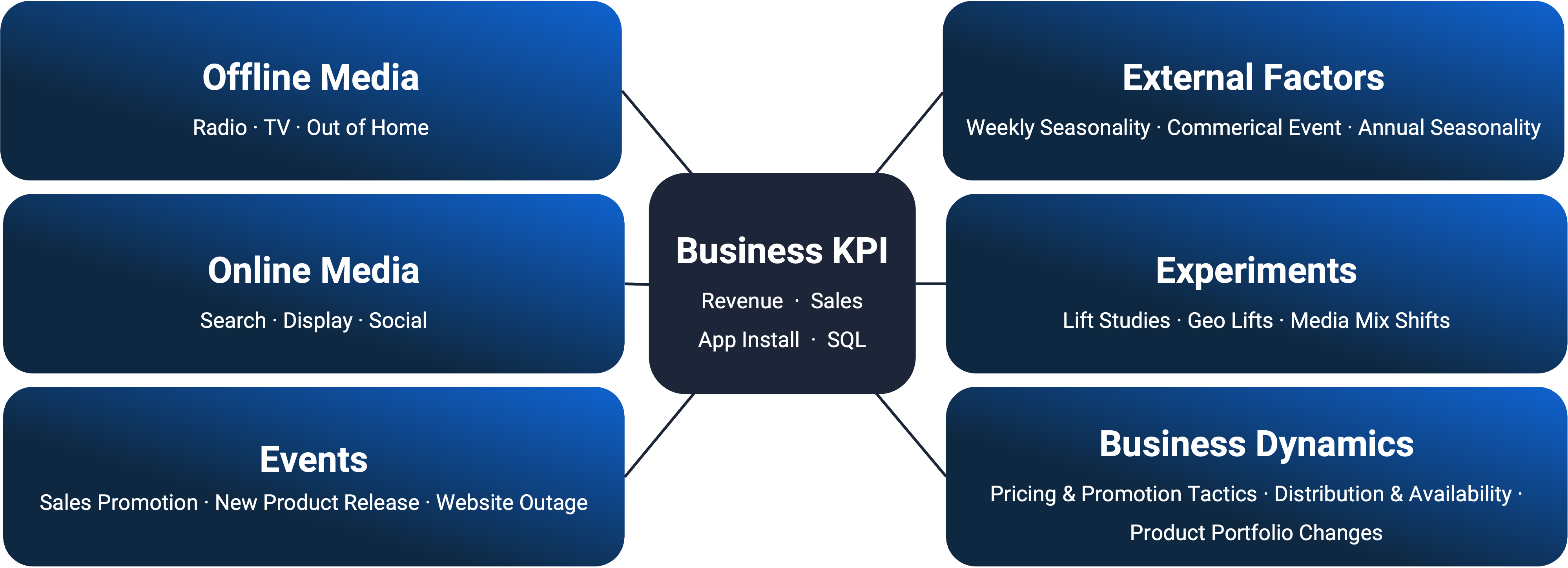
MMM is only as good as its inputs. The best models ingest constant marketing and business data from across online and offline channels, not just monthly summaries. They connect APIs, cleanse data and track everything from spend to conversions, all in one consistent structure.
Our experience shows that when data flows continuously into the model, marketing teams spend less time debating accuracy and more time acting on insights.
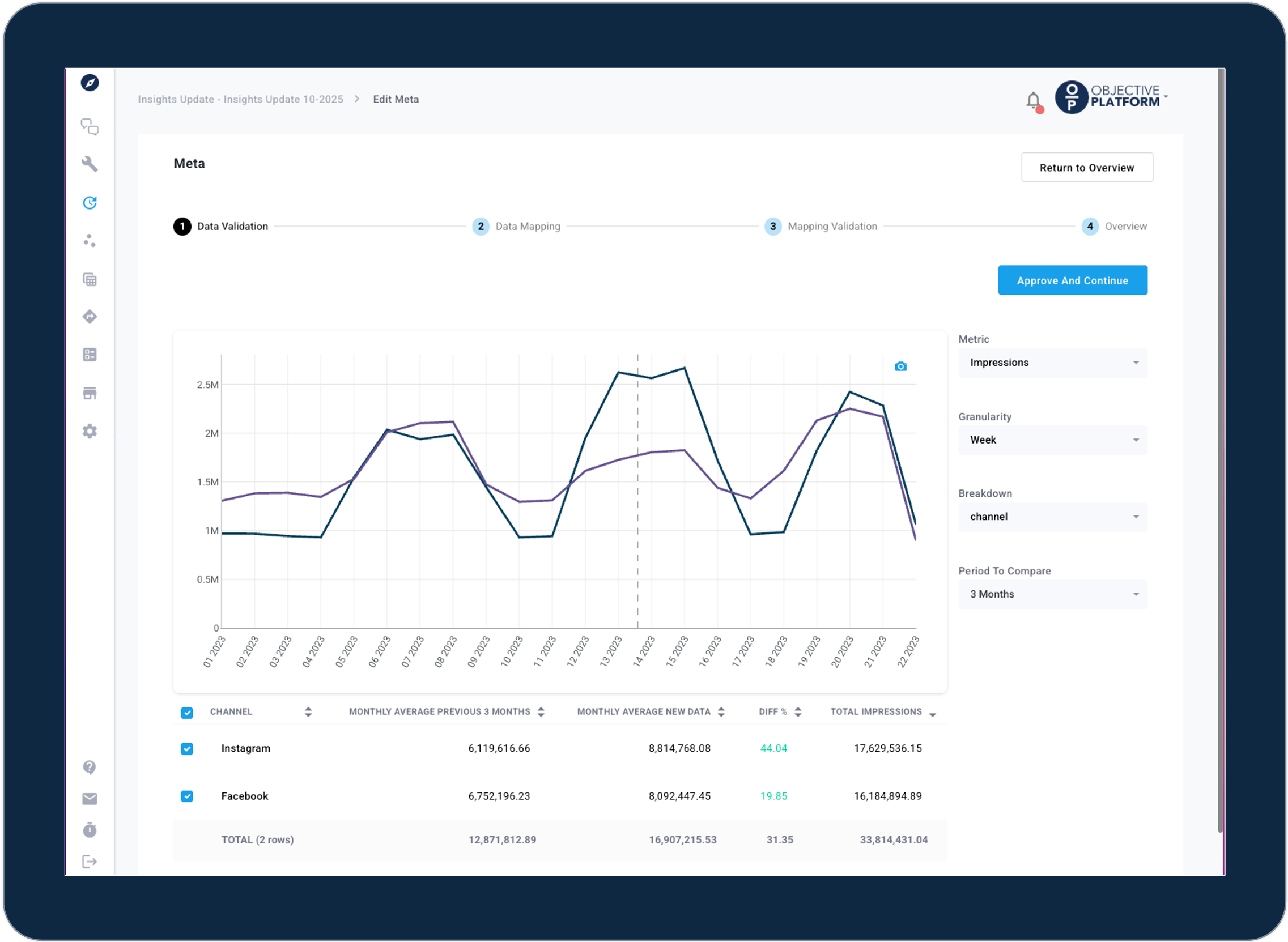
Forget once-a-year refreshes. Modern MMMs update as frequently as needed through automated pipelines, so you can see the impact of new campaigns without much delay. Model latency (the lag between action and insight) is the difference between planning ahead and explaining the past.
This is why our Media Scenario Planner runs “always-on” MMM updates, enabling brands to evaluate scenarios on demand, not six months later.
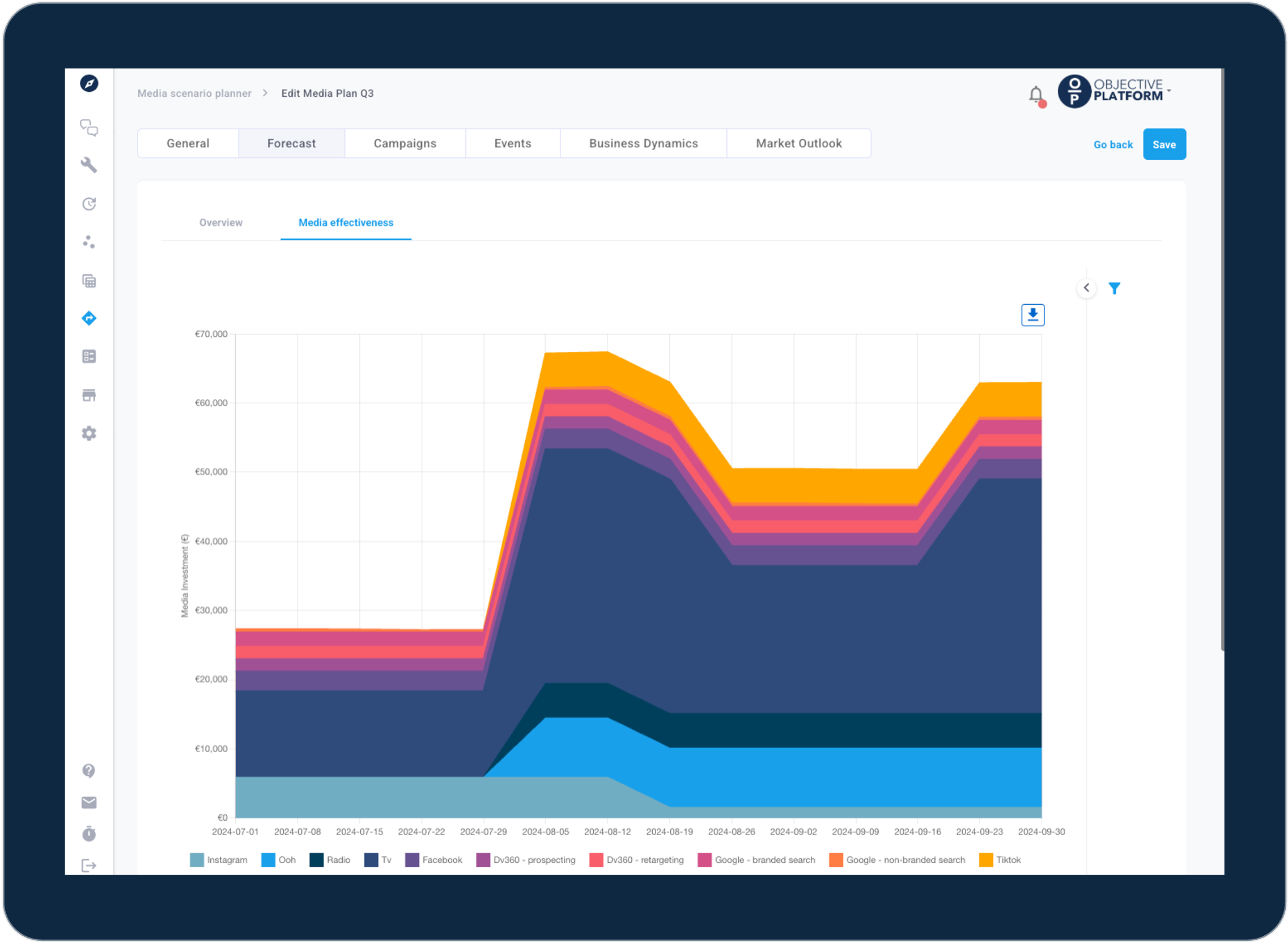
The point of MMM is to make better decisions. The best solutions let you run what-if scenarios, simulate budget shifts, and test the effect of moving money between channels, brands or campaigns. They connect measurement to planning, as a proper workflow. This is where many marketers experience the “aha” moment: when they stop extrapolating the potential of every campaign manually, trying to eyeball saturation curves with a calculator, and start simulating it all at scale.

Objective Platform Media Scenario Planner showing cross-campaign budget optimisation across channels
MMM only works if finance trusts it and marketing actually uses it. That means accessible dashboards, transparent methodology and shared KPIs. The finance team sees the ROI logic, the marketing team sees the levers to pull and the CMO gets a clear, consistent narrative.
At Objective Platform, we’ve learned that true MMM adoption happens when finance and marketing speak the same language – and the model sits in the middle.
You don’t need a PhD to benefit from MMMs but basic understanding of statistics certainly helps if you want to understand what it does. The best MMMs show the underlying structure: how channels interact, what assumptions are baked in, how halo effects are quantified. Transparency builds confidence, and confidence drives adoption. Our platform shows every step of the model, so clients can trace outcomes back to inputs: no black boxes, no surprises.
There’s a lot of noise about AI in measurement. Yes, AI can certainly help: speeding up data cleaning, surfacing insights and making simulation more accessible. But when a vendor claims their MMM is “fully AI-driven”, be cautious. MMM, when combined with well-designed experiments, is about uncovering causality, not just spotting statistical patterns. Good models are built through iteration, shaped by feedback, and refined with business context in mind. And once the models are signed off, it still takes human judgement to interpret the results, challenge assumptions, and translate outputs into real-world decisions.
Even with the smartest platform, MMM only delivers value when it’s guided by people who understand your business context. Despite being a SaaS player, we’ve seen that our clients’ success comes from collaboration - our experts helping translate the model’s output into real-world decisions. If someone tells you their MMM is completely automated, with no human interpretation required, that’s your cue to run!
If you’re stuck with an attribution model that’s losing signal, it’s time to move on. But don’t just replace one black box with another. Look for a solution that’s granular, transparent, fast and collaborative, powered by technology, but grounded in people who know how to use it.
That’s what we believe MMM should do. And that’s what we’ve built Objective Platform to deliver.
What is wrong with digital attribution models?
Digital attribution models only track online touchpoints and assign credit based on clicks or interactions within a defined window. They miss offline channels entirely, cannot account for external factors like seasonality or competitor activity and tend to over-credit lower-funnel channels like paid search. As privacy regulations tighten and cookie tracking becomes less reliable, the signal they capture continues to shrink.
What is Marketing Mix Modelling and how is it different from attribution?
Marketing Mix Modelling uses statistical analysis of aggregated historical data to measure the contribution of all marketing and non-marketing factors to business outcomes. Unlike attribution, it covers both online and offline channels, accounts for external factors like pricing and seasonality and measures long-term brand effects alongside short-term media response. It does not track individual users, making it privacy-safe by design.
How long does it take to implement an MMM?
Implementation timelines vary depending on data readiness and the complexity of your media mix. With a SaaS platform that automates data ingestion, initial model outputs can be available within weeks rather than months. The more important factor is data quality: models built on continuous, granular data produce more reliable outputs than those built on monthly summaries.
How do you get finance to trust MMM outputs?
Finance teams trust measurement when they can see the methodology behind it. A transparent, white-box model that shows how each variable contributes to the output is far easier to defend in a CFO conversation than a black-box tool that produces unexplained ROI figures. Shared KPIs and accessible dashboards that both marketing and finance can navigate also help close the gap between the two functions.
Can MMM replace attribution entirely?
MMM and attribution answer different questions and work best in combination. Attribution provides granular, touchpoint-level visibility into online journeys. MMM provides the strategic, aggregated view of how all channels and external factors drive business outcomes over time. Using both alongside incrementality experiments gives you the most complete picture of marketing effectiveness.


