.png)
Traditional Marketing Mix Modelling measures media channels in isolation. Holistic Marketing Mix Modelling, or HMM, goes further by incorporating non-media factors, a media hierarchy that allows for campaign-level granularity, Bayesian statistics that blend past business knowledge with current data and automated pipelines that deliver insights continuously rather than annually. The result is a model that reflects how your business actually works, not just how your media spend is distributed.
Marketing measurement has become more complicated. Privacy regulations have reduced the availability of user-level tracking data, and the individual touchpoint data that multi-touch attribution (MTA) models rely on is increasingly difficult to collect reliably. As a result, many organisations are returning to Marketing Mix Modelling as their primary measurement approach. he challenge is that traditional MMM, while privacy-safe and channel-agnostic, operates at a level of aggregation that loses the granularity marketers need to make campaign-level decisions. You can see that TV is working, but not which campaign type or product group is driving the results.
Objective Platform developed the Holistic Marketing Model (HMM) to close this gap. HMM incorporates practices from MTA alongside traditional MMM, measuring performance at both channel and campaign levels while integrating business knowledge that neither approach captures alone. It is not a direct substitute for MTA, but it retains a level of granularity that makes it genuinely useful for performance marketing decisions.
Traditional MMM focuses on media channels: TV, paid search, social, display and so on. It tells you how each channel contributed to conversions or revenue. What it does not tell you is how non-media factors – pricing changes, seasonal demand, competitor activity, promotions or distribution shifts – affected those same outcomes. This matters because no marketing campaign operates in a vacuum. If a competitor drops their prices during your peak campaign period, your results will look different than if they had not. If you attribute all the uplift to your media spend without accounting for that, your model gives you a distorted picture. HMM incorporates both media and non-media factors into a single model. This shifts the measurement from a media reporting tool into a genuine source of truth for business performance. Once you understand all the factors driving your outcomes, you can make decisions based on what is actually happening rather than what your media dashboard shows.

Standard MMM attributes value at the channel level and treats variations within a channel as unrelated. It can only estimate the impact of a single campaign at a time, which limits how much you can learn from it. What you cannot easily see is which product group, campaign type or individual campaign was responsible for that performance. The obvious solution – adding more variables to the model – creates a different problem. The more variables you add, the greater the risk of overfitting: a model that fits historical data very well but loses its ability to predict accurately. You solve one problem and create another.
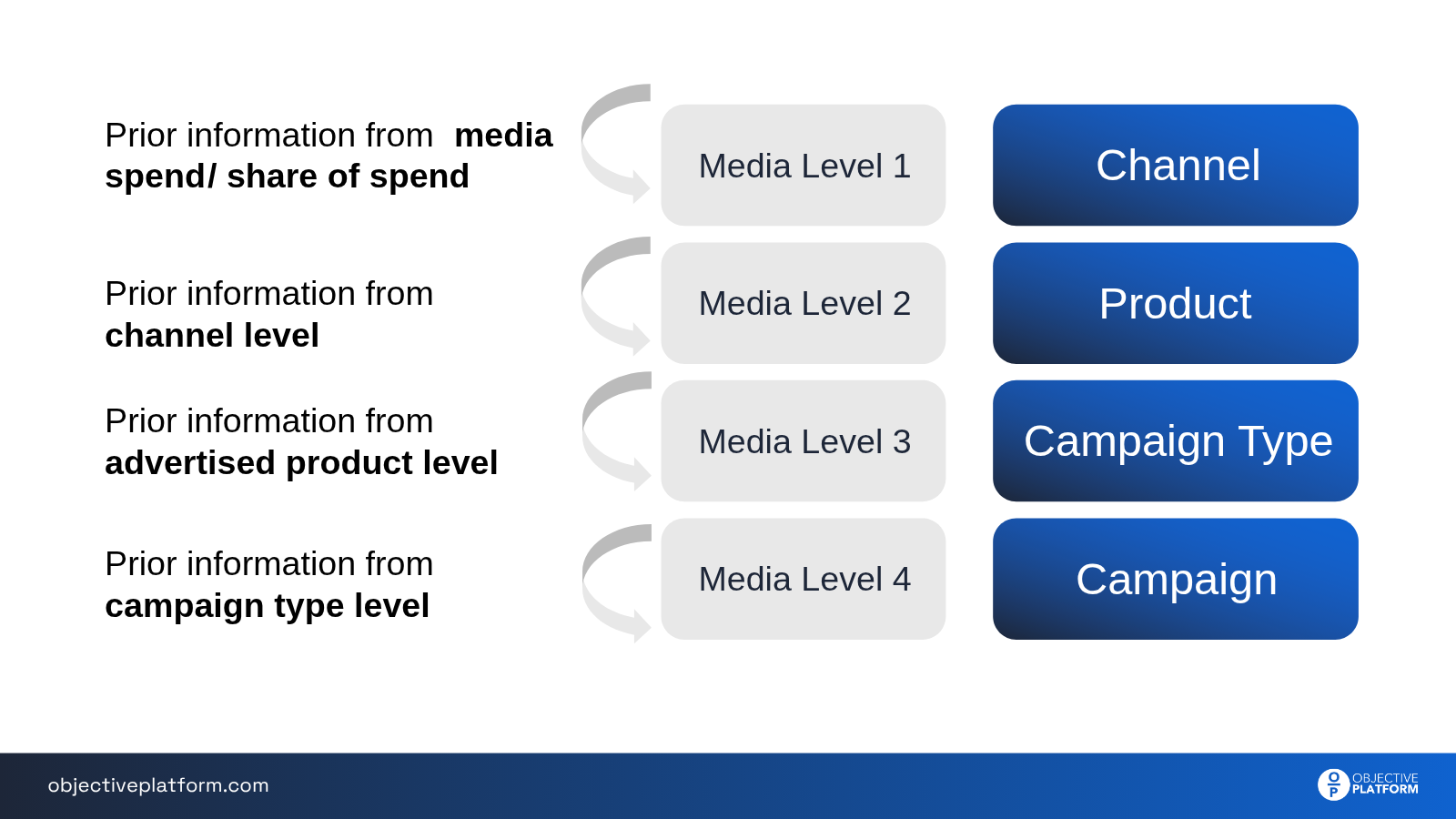
HMM resolves this with a media hierarchy approach. Rather than treating each campaign as a separate variable, the model is trained to understand the relationship between campaigns, campaign types, channels and communication goals. This hierarchy allows the model to become progressively more granular without the instability that comes from simply adding variables. The result is campaign-level insight within a model that remains statistically reliable.
.png)
One of the practical challenges with any statistical model is data availability. If you are launching in a new market, introducing a new product or simply working with a shorter historical dataset, a model built on data alone will produce unreliable outputs. HMM is built on Bayesian statistics, which allows the model to incorporate prior knowledge alongside observed data. In practice, this means you can feed in what you already know about how your channels typically perform, what your historical conversion rates look like and what results your incrementality experiments have produced. The model uses this as a starting point and updates its estimates as new data comes in.
This makes HMM particularly useful for organisations that do not yet have years of clean historical data. Rather than waiting until you have a perfect dataset, the model can produce reliable outputs from the start and improve over time as more data accumulates. Results from geo-lift tests and other experiments can also be incorporated directly as calibration inputs, improving accuracy without requiring additional data collection.
Traditional MMM was slow by design. Data collection was manual, model runs took time and outputs arrived as quarterly or annual reports. By the time the insights landed, the campaigns they were meant to inform had already run.
HMM is built around automated data pipelines. Data from online and offline channels flows into the model continuously, model updates run on a regular schedule and outputs are available in dashboards rather than slide decks. This means marketing teams can see the impact of a new campaign within days rather than months and can use the model for forward planning rather than retrospective reporting.
Automation also lowers the barrier to using MMM across an organisation. When insights are available in a dashboard that anyone can access, measurement stops being the exclusive domain of data scientists and becomes a tool that media planners, brand managers and finance teams can all work with directly.
The shift away from user-level tracking data is not temporary. Privacy regulations are tightening, cookie-based measurement is becoming less reliable and the data inputs that MTA models depend on are shrinking. Organisations that continue to rely on these approaches will find their measurement becoming less accurate over time, not more.
HMM offers a measurement approach that is built for this environment. Because it operates on aggregated data rather than individual user tracking, it is privacy-safe by design. Because it incorporates non-media factors, business knowledge and campaign-level hierarchy, it produces insights that are specific enough to be actionable. And because it is always on and automated, it supports the kind of continuous optimisation that modern marketing teams need.
Adopting HMM means you can:
What is the difference between traditional MMM and Holistic Marketing Mix Modelling?
Traditional MMM measures the contribution of media channels to business outcomes using aggregated historical data. Holistic Marketing Mix Modelling extends this by incorporating non-media factors such as pricing, promotions and competitor activity, adding a media hierarchy that enables campaign-level granularity and using Bayesian statistics to blend prior business knowledge with observed data. The result is a model that reflects the full range of factors driving business performance, not just media spend.
What is the Holistic Marketing Model (HMM)?
The Holistic Marketing Model is Objective Platform's approach to Marketing Mix Modelling. It combines elements of traditional MMM and multi-touch attribution, measures performance at channel and campaign level, incorporates non-media factors and uses Bayesian statistics to improve reliability when data is limited. It is designed to be always on and automated, delivering continuous insights through dashboards rather than periodic reports.
What are Bayesian statistics and why do they matter for MMM?
Bayesian statistics is a statistical approach that combines observed data with prior knowledge to produce probability estimates. In the context of MMM, this means the model can incorporate what an organisation already knows about channel performance, historical conversion rates and experiment results alongside new data. This makes models more reliable when historical datasets are limited and allows them to improve over time as more data accumulates.
How is HMM different from multi-touch attribution?
Multi-touch attribution tracks individual user journeys across digital touchpoints and assigns credit to each interaction. It provides granular, touchpoint-level visibility but depends on user-level tracking data that is increasingly restricted by privacy regulations. HMM operates on aggregated data, making it privacy-safe by design. It does not track individual users but achieves campaign-level granularity through its media hierarchy structure. The two approaches answer different questions and can be used in combination.
Why is campaign-level granularity important in MMM?
Channel-level MMM tells you that a channel is working but not which part of your activity within that channel is driving results. Campaign-level granularity allows you to distinguish between campaign types, product groups and individual campaigns within a channel. This makes it possible to optimise at a level that is actually actionable for media planners and brand managers, rather than producing insights that are too aggregated to act on.